Medieval Europe · 768–814 (crowned emperor 800)
Why Was Charlemagne Crowned Emperor in 800?
In short
- Charlemagne's family replaced the Merovingians in 751; he ruled from 768 and conquered much of western Europe.
- Pope Leo III crowned him emperor on Christmas Day 800, reviving a title unused in the West since 476.
- His court revived learning and created the script behind our lower-case letters, but his empire split after 843.
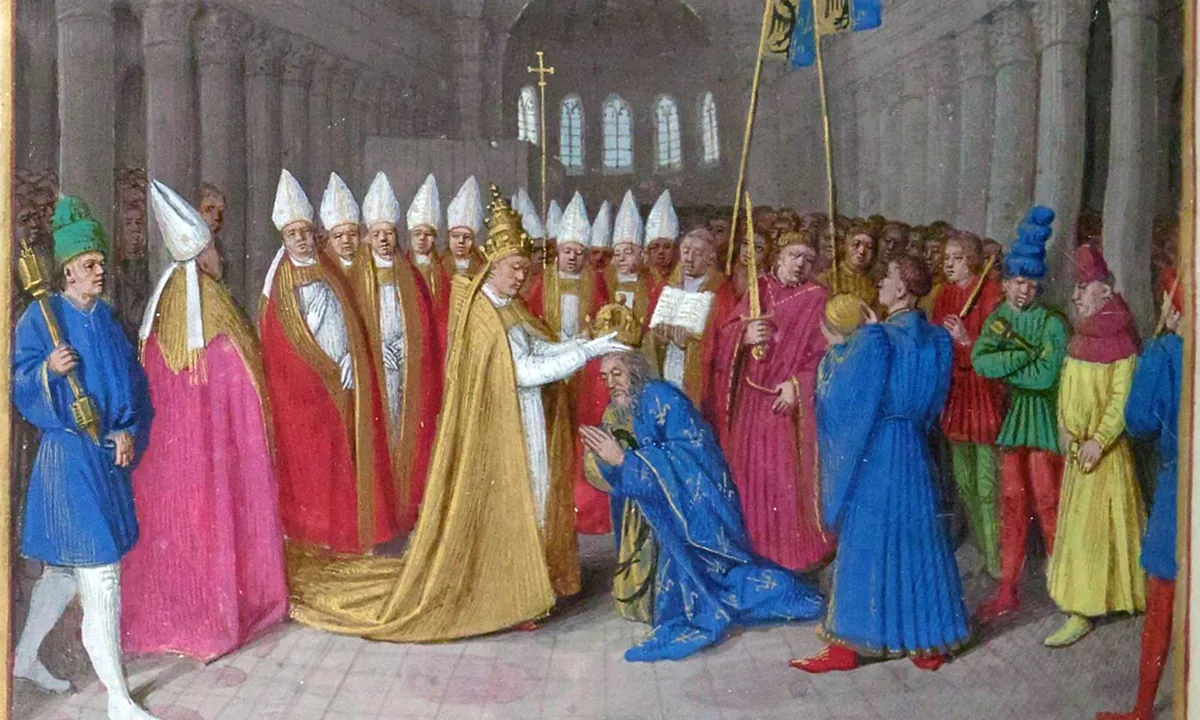
On Christmas Day 800, in St Peter's in Rome, the king of the Franks rose from prayer and Pope Leo III set a crown on his head while the crowd acclaimed him emperor. Charles's biographer Einhard later insisted that the king would never have entered the church that day had he known what the pope intended. Historians are still arguing about whether to believe him.
A new royal family
By the 8th century the Merovingian kings had become figureheads. Real power lay with their chief officials, the mayors of the palace. One of them, Charles Martel, defeated an Arab raiding army near Poitiers in 732 or 733. His son Pippin went further: in 751, with the pope's approval, he sent the last Merovingian king to a monastery and took the crown himself.
Einhard later mocked the old kings for travelling in ox-carts and reciting speeches written for them. He was writing for the family that replaced them. When Pippin died in 768, his sons Charles and Carloman shared the kingdom; after Carloman died in 771, Charles ruled alone.
War almost every year
Charles, later called Charlemagne, “Charles the Great”, spent most of his reign at war. In 774 he conquered the Lombard kingdom of northern Italy and took its crown. In the 790s his armies seized the treasure of the Avars on the Danube. His war against the pagan Saxons lasted, on and off, from 772 to 804.
It was brutal. The Royal Frankish Annals say that at Verden in 782 he had 4,500 Saxons beheaded in a day; historians debate the number, not the cruelty. A law for Saxony threatened death to anyone who refused baptism. Even Alcuin, his leading scholar, protested that faith must be freely chosen.
Not every campaign went well. In 778, returning from Spain, his rearguard was ambushed in the Pyrenees by Basques. The Song of Roland, written some three centuries later, turned the attackers into Muslims.

A pope in trouble
In 799 Pope Leo III was attacked in a Roman street by relatives of his predecessor, who accused him of perjury and adultery. He escaped and fled north to Charles at Paderborn. In late 800 Charles came to Rome; on 23 December Leo publicly swore to his innocence, and two days later he crowned the king.
Both men gained. Leo had a protector who owed his crown to the pope; Charles had a title no western ruler had held since 476. In Constantinople the empire was ruled by a woman, Irene, and some Franks argued that the imperial throne was therefore empty. The Byzantines saw a usurper. Only in 812 did envoys from Constantinople hail Charles as emperor.
Books, schools and a new script
Charles gathered scholars at his court, among them Alcuin of York. A decree of 789 ordered monasteries and cathedrals to keep schools and correct their books. Scribes developed a clear, rounded hand now called Carolingian minuscule, the ancestor of the lower-case letters on this screen. Many classical Latin works survive only because Carolingian monks copied them.
Charles himself, Einhard says, kept writing tablets under his pillow to practise his letters at night, but began too late in life to succeed. He could probably read, and he signed documents by adding a stroke to a monogram of his name. He also standardised the silver coinage: 12 pennies to a shilling, 20 shillings to a pound.

Father of Europe?
Charles died at Aachen in 814 and was buried in the chapel he had built there. His son Louis the Pious held the empire together, but Louis's sons fought over it. The Treaty of Verdun in 843 split it three ways; its western and eastern parts roughly foreshadow France and Germany.
A court poem of around 799 called him “father of Europe”, and modern Europe has adopted him: since 1950 the city of Aachen has awarded a Charlemagne Prize for work towards European unity. Yet his empire was made by conquest and forced conversion, and it left out Britain, most of Spain and southern Italy.

In their own words
“It was then that he received the titles of Emperor and Augustus, to which he at first had such an aversion that he declared that he would not have set foot in the Church the day that they were conferred, although it was a great feast-day, if he could have foreseen the design of the Pope.”
Einhard, Life of Charlemagne (Vita Karoli Magni), chapter 28, c. 817–830 CE
Translation by Samuel Epes Turner (1880). Einhard knew Charles well, but he modelled his book on Suetonius's Lives of the Caesars, and a show of reluctance to accept power was a classical convention. Historians read the passage as modesty, as irritation that the pope took the initiative, or both.
Why it happened
- The Merovingian kings had lost real power to the mayors of the palace, Charlemagne's family.
- Decades of conquest made Charles master of most of the Latin Christian West.
- Pope Leo III needed a powerful protector against his enemies in Rome.
What happened next
- The western imperial title passed to German kings from 962 and lasted until 1806.
- Carolingian copying preserved much of classical Latin literature and gave Europe its lower-case script.
- Divided after 843, the Frankish kingdoms struggled to defend their coasts and rivers against Viking fleets. Read the story →
- Popes and emperors had tied their authority together, setting up later clashes over who ranked higher. Read the story →
Why it still matters
Until 15 February 1971, British money still ran on Carolingian arithmetic: 12 pence to a shilling, 20 shillings to a pound, 240 pence in all. The pound sign, £, comes from libra, the Carolingian pound of account. A reckoning system fixed by Frankish kings outlived their empire by more than a thousand years.
Key people
- Charlemagne (Charles the Great)
- King of the Franks from 768 and emperor from 800 until his death in 814
- Pope Leo III
- Pope (795–816) who crowned Charles emperor after Charles restored him in Rome
- Einhard
- Courtier and scholar whose Life of Charlemagne is the main portrait of the king
- Alcuin of York
- Northumbrian scholar who led Charles's court school and protested against forced conversion
- Irene
- Empress in Constantinople (797–802), whose rule let some Franks call the imperial throne vacant
Key terms
- Mayor of the palace
- The chief official of the Merovingian court; by the 8th century, the real ruler of the Frankish kingdom.
- Carolingian
- From Carolus, Latin for Charles: the dynasty of Charles Martel, Pippin and Charlemagne, and the culture of their age.
- Carolingian minuscule
- The clear, rounded script developed under Charlemagne; Renaissance scholars copied it, and it became our lower-case alphabet.
- Holy Roman Empire
- Later name for the revived western empire; “holy” was added in the 12th century and the full title in 1254. It lasted until 1806.
Test yourself
Who ruled the empire in Constantinople when Charles was crowned in 800?
- The empress Irene
- The emperor Justinian
- The emperor Alexios
- The empress Theodora
Show the answer
The empress Irene. Irene ruled in her own name from 797 to 802, and some Franks argued that a woman could not hold the imperial title. Justinian and Theodora lived in the 6th century; Alexios in the 11th.
The full lesson in the app ends with 5 questions like this one.
Connected stories
- The Fall of the Western Roman Empire: The western imperial title, abandoned when Romulus Augustulus was deposed in 476, was revived for Charles in 800.
- Clovis and the Kingdoms After Rome: Charles inherited the Catholic Frankish kingdom that Clovis had founded, and its alliance with the bishops.
- Canossa: A King in the Snow: A pope crowning an emperor raised a question that exploded under Gregory VII: who stood higher?
Frequently asked questions
Why did the pope crown Charlemagne?
The Merovingian kings had lost real power to the mayors of the palace, Charlemagne's family. Decades of conquest made Charles master of most of the Latin Christian West. Pope Leo III needed a powerful protector against his enemies in Rome.
What was the legacy of Charlemagne?
The western imperial title passed to German kings from 962 and lasted until 1806. Carolingian copying preserved much of classical Latin literature and gave Europe its lower-case script. Divided after 843, the Frankish kingdoms struggled to defend their coasts and rivers against Viking fleets. Popes and emperors had tied their authority together, setting up later clashes over who ranked higher.
Who ruled the empire in Constantinople when Charles was crowned in 800?
The empress Irene. Irene ruled in her own name from 797 to 802, and some Franks argued that a woman could not hold the imperial title. Justinian and Theodora lived in the 6th century; Alexios in the 11th.
What is the main primary source for “Charlemagne: An Emperor in the West Again”?
Einhard, Life of Charlemagne (Vita Karoli Magni), chapter 28 (c. 817–830 CE). Translation by Samuel Epes Turner (1880). Einhard knew Charles well, but he modelled his book on Suetonius's Lives of the Caesars, and a show of reluctance to accept power was a classical convention. Historians read the passage as modesty, as irritation that the pope took the initiative, or both.
Sources
- Einhard, Two Lives of Charlemagne (Einhard and Notker the Stammerer), translated by David Ganz (2008)
- Johannes Fried, Charlemagne: The Man and the Myth, translated by Peter Lewis (2016)
- Rosamond McKitterick, Charlemagne: The Formation of a European Identity (2008)
- Chris Wickham, The Inheritance of Rome: A History of Europe from 400 to 1000 (2009)
Images are credited under each picture. Paintings and photographs come from public collections via Wikimedia Commons; scenes with no surviving image are marked as illustrations.
