Medieval Europe · 481–511 CE
Who Was Clovis, King of the Franks?
In short
- After 476, Germanic kings ruled the western provinces through Roman cities, bishops and law.
- Clovis united most of Gaul, defeating Syagrius in 486 and the Visigoths in 507.
- His Catholic baptism, told by Gregory of Tours as a new Constantine story, tied the Franks to the Church.
At a review of his troops around 487, a Frankish king stopped in front of one warrior, criticised his weapons and threw his axe to the ground. As the man bent to pick it up, the king split his skull and said: “This is what you did to the vase at Soissons.” The king was Clovis, and the story says a lot about how power worked in the West after Rome.
Kings in Roman clothes
When the western empire dissolved, its provinces did not empty. They passed to kings: Visigoths in Spain and southern Gaul, Burgundians in the Rhône valley, Vandals in Africa and, from 493, the Ostrogoth Theoderic in Italy. Most ruled a Roman majority through Roman officials, Roman law and Latin paperwork.
In northern Gaul, the Franks were a coalition of warbands that had long fought for Rome. In 1653 workmen at Tournai, in modern Belgium, found the grave of Clovis's father, Childeric, who died around 481. It held a signet ring inscribed CHILDIRICI REGIS, “of King Childeric”, the gold brooch of a Roman official and hundreds of small gold-and-garnet bees. Childeric was a Frankish king and probably a Roman commander too.
The vase of Soissons
Clovis became king as a teenager. In 486 he defeated Syagrius, a Roman general who still ruled a pocket of northern Gaul from Soissons. Gregory of Tours, the bishop who wrote the main history of the Franks about a century later, tells what happened next.
A church had lost a precious vase in the looting, and its bishop asked for it back. Clovis asked his men to let him take it on top of his share. One warrior refused, smashed the vase with his axe and shouted that the king would get only what the lot gave him. Clovis said nothing. At the spring muster the next year, he took his revenge.
The story shows the two halves of the new power. The king needed the bishops who ran Gaul's cities, and he needed warriors who expected their share of the plunder.

Another Constantine
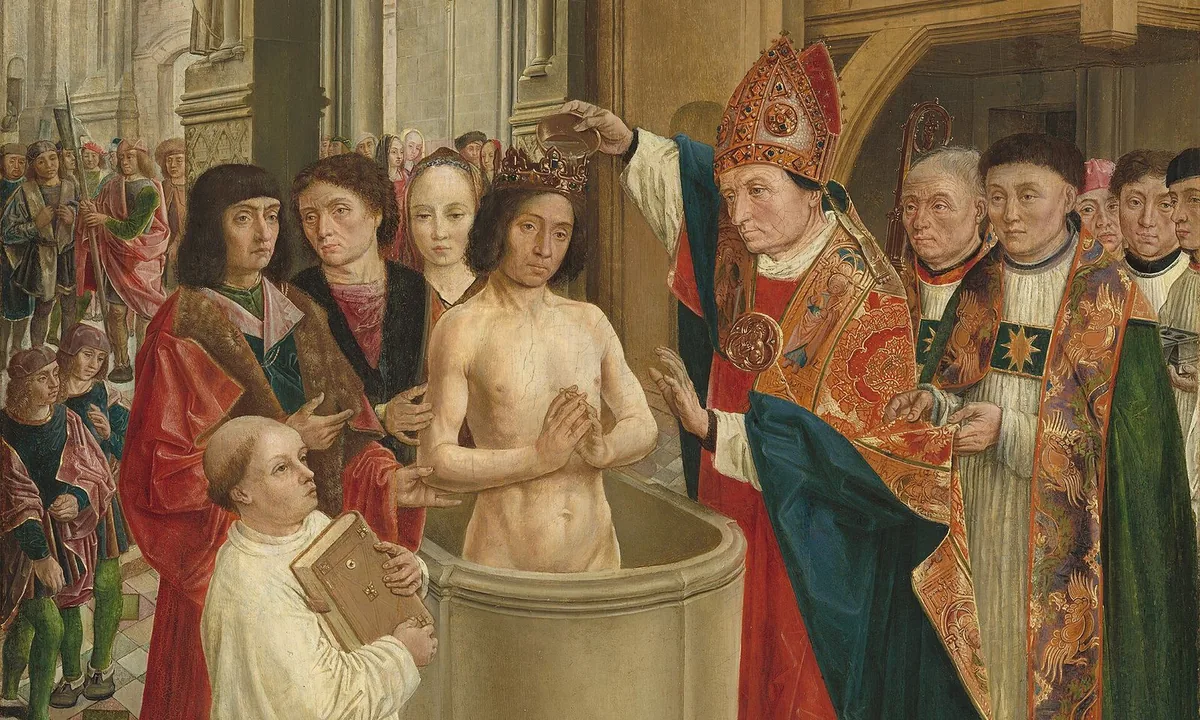
Clovis married Clotilde, a Burgundian princess and a Catholic Christian. Gregory says that in a desperate battle against the Alamanni, Clovis promised to convert if her God gave him victory. He won, and Bishop Remigius baptised him at Reims, along with, Gregory claims, more than 3,000 of his warriors.
Gregory modelled the scene on the conversion of the emperor Constantine, and wrote some ninety years after it. Even the date is uncertain: historians have argued for 496, 498 and 508. The choice mattered more than the date. The Goths, Burgundians and Vandals were Arian Christians, who taught that the Son was lesser than the Father. By taking the Catholic faith of his Roman subjects, Clovis won over their bishops.
Vouillé and a consul's robe
In 507 Clovis attacked the Visigoths, who ruled Gaul south of the Loire. At Vouillé, near Poitiers, he defeated them and killed their king, Alaric II. The Visigoths kept only a strip of coast north of the Pyrenees, and their kingdom's centre shifted to Spain.
Afterwards, Gregory says, letters came from the emperor Anastasius in Constantinople granting Clovis the title of consul, and at Tours he put on a purple tunic and a diadem. The empire still conferred prestige. Clovis made Paris his main seat and had Frankish custom written down in Latin as the Salic Law. When he died in 511, his kingdom was divided among his four sons, like family property.

Were these the Dark Ages?
The idea of a “dark age” after Rome goes back to the Italian poet Petrarch, who in the 14th century contrasted the light of antiquity with the darkness that followed. Historians today prefer “early Middle Ages”. Material life did become poorer and simpler across much of the West, but kings like Clovis inherited Roman cities, bishops, law and Latin.
Another myth is that medieval people thought the earth was flat. Around 725 the English monk Bede described it as a globe, and educated writers throughout the Middle Ages agreed. The flat-earth story owes much to Washington Irving's romantic biography of Christopher Columbus, published in 1828.
In their own words
“The king therefore asked first to be baptised by the bishop. Another Constantine advanced to the font… And as he entered to be baptised, the saint of God spoke with ready eloquence: “Bow your neck gently, Sicamber; worship what you burned, burn what you worshipped.”
Gregory of Tours, Histories (History of the Franks) 2.31, written c. 575–594 CE
Translation adapted from Ernest Brehaut (1916) and Lewis Thorpe (1974). Gregory wrote some ninety years after the baptism and deliberately presents Clovis as a new Constantine. “Sicamber” refers to the Sicambri, an ancient Germanic people with whom the Franks were associated.
Why it happened
- The collapse of imperial government left Roman provinces to the commanders of barbarian armies.
- Frankish kings had served Rome and inherited its military and administrative networks in northern Gaul.
- Clovis's Catholic baptism won him the support of the bishops who led Gaul's Roman population.
What happened next
- The Merovingian dynasty ruled the Franks until 751, when Charlemagne's father Pippin took the crown. Read the story →
- Frankish Gaul gave its name to France, and Clovis's name, Chlodovech, became Louis, the name of French kings up to Louis XVIII.
- Catholic Frankish kings became the papacy's natural allies in the West. Read the story →
Why it still matters
In September 1996 Pope John Paul II visited Reims to mark 1,500 years since the traditional date of Clovis's baptism, and thousands marched in protest. Supporters called the baptism the birth of Christian France; critics replied that a Frankish warlord's conversion should not define a secular republic. A king who died in 511 could still start an argument in the 1990s.
Key people
- Clovis
- King of the Franks (c. 481–511) who conquered most of Gaul and became a Catholic Christian
- Clotilde
- Burgundian princess and Catholic, Clovis's wife; later venerated as a saint
- Remigius
- Bishop of Reims who baptised Clovis
- Gregory of Tours
- Bishop and historian (c. 538–594) whose Histories are the main source for Clovis
- Alaric II
- King of the Visigoths, defeated and killed by Clovis at Vouillé in 507
Key terms
- Merovingians
- Clovis's dynasty, named after his legendary grandfather Merovech; it ruled the Franks until 751.
- Arianism
- A form of Christianity, held by most Gothic and Vandal kings, which taught that Christ the Son was subordinate to God the Father.
- Salic Law
- The Frankish law code written down in Latin under Clovis, setting out compensation payments for crimes and injuries.
- Early Middle Ages
- Historians' term for roughly 500–1000 CE, preferred to “Dark Ages” because it does not prejudge the period.
Test yourself
Whom did Clovis defeat at Soissons in 486?
- Alaric II, king of the Visigoths
- Syagrius, a Roman general
- Theoderic, king of the Ostrogoths
- Gundobad, king of the Burgundians
Show the answer
Syagrius, a Roman general. Syagrius still ruled a Roman enclave in northern Gaul from Soissons. Clovis defeated Alaric II later, at Vouillé in 507, while Theoderic ruled Italy and Gundobad the Burgundians.
The full lesson in the app ends with 5 questions like this one.
Connected stories
- The Fall of the Western Roman Empire: The end of imperial rule in the West in the 5th century left Gaul to rival kings, of whom Clovis proved the strongest.
- Charlemagne: An Emperor in the West Again: Charlemagne's family replaced Clovis's descendants in 751 and built on the Frankish kingdom he created.
Frequently asked questions
How did Clovis come to rule Gaul?
The collapse of imperial government left Roman provinces to the commanders of barbarian armies. Frankish kings had served Rome and inherited its military and administrative networks in northern Gaul. Clovis's Catholic baptism won him the support of the bishops who led Gaul's Roman population.
Why does Clovis matter today?
The Merovingian dynasty ruled the Franks until 751, when Charlemagne's father Pippin took the crown. Frankish Gaul gave its name to France, and Clovis's name, Chlodovech, became Louis, the name of French kings up to Louis XVIII. Catholic Frankish kings became the papacy's natural allies in the West.
Whom did Clovis defeat at Soissons in 486?
Syagrius, a Roman general. Syagrius still ruled a Roman enclave in northern Gaul from Soissons. Clovis defeated Alaric II later, at Vouillé in 507, while Theoderic ruled Italy and Gundobad the Burgundians.
What is the main primary source for “Clovis and the Kingdoms After Rome”?
Gregory of Tours, Histories (History of the Franks) 2.31 (written c. 575–594 CE). Translation adapted from Ernest Brehaut (1916) and Lewis Thorpe (1974). Gregory wrote some ninety years after the baptism and deliberately presents Clovis as a new Constantine. “Sicamber” refers to the Sicambri, an ancient Germanic people with whom the Franks were associated.
Sources
- Gregory of Tours, Histories (History of the Franks), Book 2, translated by Lewis Thorpe (1974)
- Chris Wickham, The Inheritance of Rome: A History of Europe from 400 to 1000 (2009)
- Ian Wood, The Merovingian Kingdoms, 450–751 (1994)
- Edward James, The Franks (1988)
Images are credited under each picture. Paintings and photographs come from public collections via Wikimedia Commons; scenes with no surviving image are marked as illustrations.
