Ancient Greece · 399 BCE
Why Was Socrates Executed? The Trial and Death of Socrates
In short
- Socrates questioned Athenians until they admitted their ignorance; he wrote nothing, and we know him through Plato, Xenophon and Aristophanes.
- In 399 BCE he was tried for impiety and corrupting the young, partly because of his friendships with Alcibiades and Critias.
- Condemned to death, he refused to escape and drank hemlock in prison.
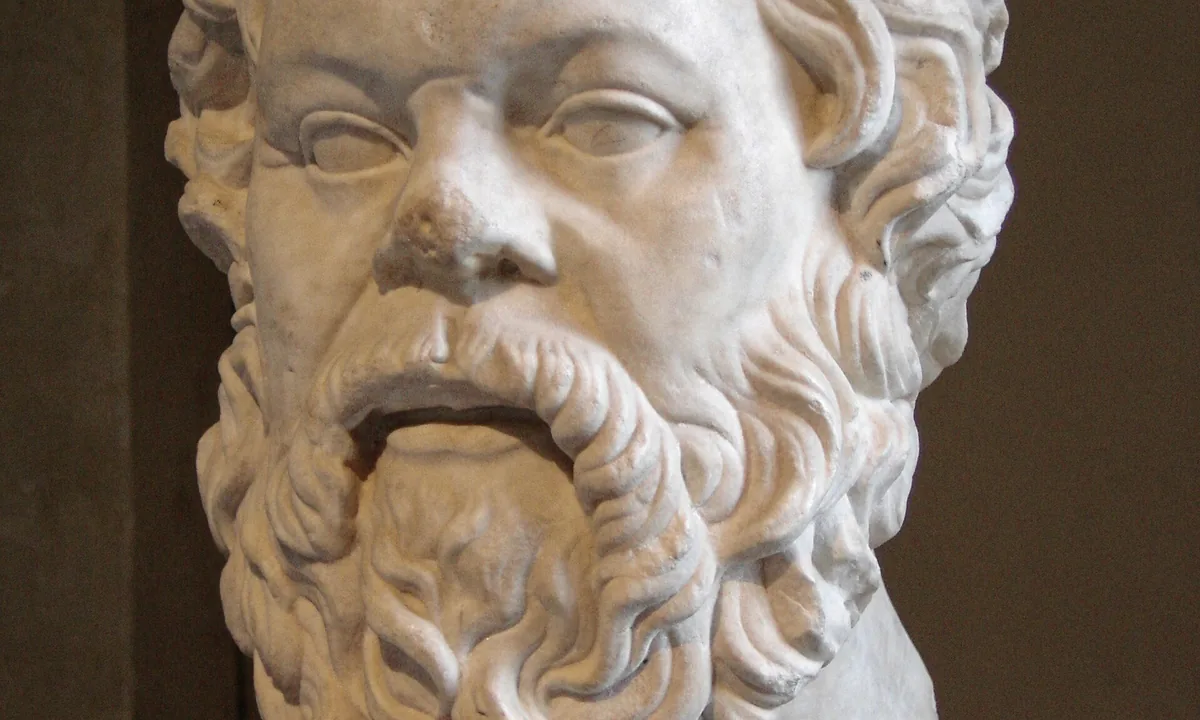
In 399 BCE five hundred Athenian citizens, picked by lot, sat in judgement on a man of seventy. In a single day they heard the case and found him guilty. Asked to suggest his own penalty, he proposed that the city should give him free dinners for the rest of his life.
The man in the agora
Socrates was born around 470 BCE, the son of a stonemason and a midwife. He was poor, snub-nosed and often barefoot, and he served as a hoplite in three campaigns of the Peloponnesian War. He spent his days in the agora and the gymnasiums, asking people questions.
What is courage? What is justice? He would take a confident answer apart, question by question, until the speaker admitted he did not know. Young men loved to watch. Their victims did not. Socrates wrote nothing; we know him through his followers Plato and Xenophon, and through Aristophanes' comedy The Clouds (423 BCE), which mocked him as a crank who taught young men to win arguments by cheating.

No one wiser
In Plato's account, Socrates' friend Chaerephon once asked the oracle at Delphi whether anyone was wiser than Socrates. The answer was no. Puzzled, Socrates set out to find someone wiser: politicians, poets, craftsmen. Each thought he knew things he did not.
The only difference, Socrates concluded, was that he did not imagine he knew what he did not know. He saw his questioning as a duty to the god, and to Athens.

Dangerous friends
Socrates obeyed the law when it was dangerous to do so. In 406 BCE he alone on the council's presiding committee opposed an illegal mass trial of generals. Under the Thirty Tyrants he refused their order to arrest an innocent man, Leon of Salamis.
But his friends included Alcibiades, the traitor, and Critias, the most violent of the Thirty. After the democracy returned in 403 BCE, an amnesty forbade prosecutions for what had happened under the Thirty. Any case against Socrates would have to be framed another way.
The trial
The charge, brought by Meletus with the backing of the democratic leader Anytus, was that Socrates did not recognise the gods the city recognised, introduced new divine powers and corrupted the young.
In Plato's version of his defence, the Apology, Socrates refused to beg. The jury of about 500 found him guilty, by roughly 280 votes to 220. When he proposed free meals as his penalty, the honour Athens gave its benefactors, and then a modest fine, the jury voted for death, by a larger majority.
The hemlock
A sacred ship had just sailed for Delos, and no one could be executed until it returned. For about a month Socrates waited in prison. His friends arranged an escape; in Plato's Crito he refuses, saying he had lived his whole life under the laws of Athens and would not break them now.
He drank the hemlock in his cell, surrounded by friends; Plato, who tells the story in the Phaedo, says he himself was ill and absent. Socrates' last words, by that account, were a reminder to his friend Crito that they owed a cockerel to Asclepius, the god of healing.

In their own words
“…if I say again that daily to discourse about virtue, and of those other things about which you hear me examining myself and others, is the greatest good of man, and that the unexamined life is not worth living, you are still less likely to believe me.”
Plato, reporting Socrates' defence speech, Apology 38a, Trial in 399 BCE; written in the following years
Translation by Benjamin Jowett (1871). Plato was at the trial, but the Apology is his own version of the speech, not a transcript.
Why it happened
- Socrates' public questioning embarrassed powerful men and made him look dangerous to young men's fathers.
- His friendship with Alcibiades and Critias tied him to Athens' worst traitors in the eyes of many.
- After defeat and civil war, Athenians were anxious to restore the gods' favour and the city's unity.
What happened next
- Plato wrote his dialogues and founded the Academy, where Aristotle studied before he tutored Alexander. Read the story →
- Socrates' death became the model of a thinker dying for his convictions.
- Plato's distrust of democracy, which had killed his teacher, shaped political thought for centuries.
Why it still matters
When Christopher Columbus Langdell became dean of Harvard Law School in 1870, he began questioning students about real cases instead of lecturing. American law schools still call this cold-calling the Socratic method.
Key people
- Socrates
- Athenian philosopher (c. 470–399 BCE) who taught by questioning and was executed for impiety
- Plato
- Socrates' follower (c. 427–347 BCE), whose dialogues are our main source for him
- Xenophon
- Athenian soldier and writer who also left memoirs of Socrates
- Anytus
- Democratic politician who backed the prosecution
- Alcibiades
- Socrates' friend, whose betrayal of Athens was remembered at the trial
Key terms
- Socratic method
- Teaching by asking questions that test a person's beliefs until contradictions appear.
- Impiety
- Asebeia: failing to honour the city's gods properly, a crime in Athens that could carry the death penalty.
- Amnesty of 403 BCE
- The agreement that restored democracy and banned prosecutions for acts committed under the Thirty Tyrants.
- Hemlock
- A poisonous plant whose extract was used for executions in Athens.
Test yourself
How do we know what Socrates taught?
- From the books he wrote on ethics
- From an official record of his trial
- From the writings of his followers, above all Plato
- From inscriptions set up in the agora
Show the answer
From the writings of his followers, above all Plato. Socrates wrote nothing. Plato and Xenophon wrote about him, and Aristophanes mocked him on stage.
The full lesson in the app ends with 5 questions like this one.
Connected stories
- Alcibiades and the Fall of Athens: Alcibiades' betrayal made Socrates' influence on the young look dangerous.
- Cleisthenes and the Birth of Democracy in Athens: The democracy Cleisthenes founded put its most famous questioner to death.
Frequently asked questions
Why was Socrates put on trial?
Socrates' public questioning embarrassed powerful men and made him look dangerous to young men's fathers. His friendship with Alcibiades and Critias tied him to Athens' worst traitors in the eyes of many. After defeat and civil war, Athenians were anxious to restore the gods' favour and the city's unity.
What happened after Socrates died?
Plato wrote his dialogues and founded the Academy, where Aristotle studied before he tutored Alexander. Socrates' death became the model of a thinker dying for his convictions. Plato's distrust of democracy, which had killed his teacher, shaped political thought for centuries.
How do we know what Socrates taught?
From the writings of his followers, above all Plato. Socrates wrote nothing. Plato and Xenophon wrote about him, and Aristophanes mocked him on stage.
What is the main primary source for “The Trial and Death of Socrates”?
Plato, reporting Socrates' defence speech, Apology 38a (Trial in 399 BCE; written in the following years). Translation by Benjamin Jowett (1871). Plato was at the trial, but the Apology is his own version of the speech, not a transcript.
Sources
- Plato, Apology, Crito and Phaedo
- Xenophon, Memorabilia and Apology of Socrates
- Emily Wilson, The Death of Socrates (2007)
- Robin Waterfield, Why Socrates Died: Dispelling the Myths (2009)
Images are credited under each picture. Paintings and photographs come from public collections via Wikimedia Commons; scenes with no surviving image are marked as illustrations.
