Ancient Greece · 415–404 BCE
Who Won the Peloponnesian War? Alcibiades and the Fall of Athens
In short
- Condemned in 415 BCE, Alcibiades went to Sparta and advised it to aid Syracuse and fortify Decelea.
- He then served the Persian Tissaphernes, returned to lead Athens to victories, and was dropped after Notium in 406 BCE.
- Lysander destroyed the Athenian fleet at Aegospotami in 405 BCE; Athens surrendered in 404, the year Alcibiades was killed.
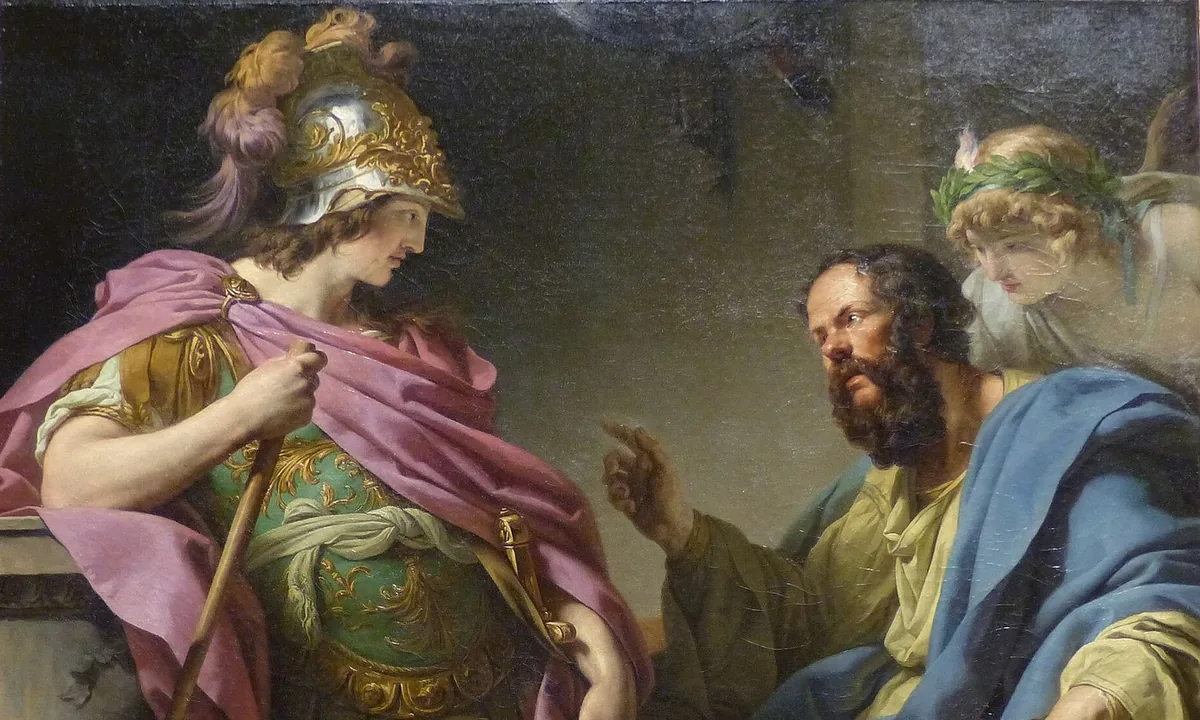
At the Olympic Games of 416 BCE one Athenian entered seven chariots, more than any private citizen before him, and took first, second and fourth place. In the twelve years he had left, he would fight for Athens, for Sparta, for a Persian governor and for Athens again.
The golden boy
Alcibiades was born around 450 BCE into one of Athens' great families. His father was killed in battle when he was a small child, and he grew up in the household of his guardian, Pericles. He was handsome, rich, clever and reckless, and Athens could not stop talking about him.
Socrates was his friend. In Plato's Symposium Alcibiades says the philosopher saved his life in battle at Potidaea and kept his head in the retreat from Delium. Plutarch tells how he cut off the tail of a very expensive dog, so that the city would gossip about that instead of something worse.
Advice for the enemy
Condemned to death in Athens in 415 BCE, Alcibiades went to Sparta and told the Spartans how to win. Send a commander to Syracuse, he said, and build a permanent fort in Attica itself.
Sparta did both. From 413 BCE a garrison at Decelea, in the hills north of Athens, kept Athenians off their farms all year round, and more than 20,000 slaves escaped to it, many of them skilled workers. Then Alcibiades fell out with his hosts; Plutarch says he had seduced the wife of the Spartan king Agis.
Persian gold and a triumphant return
In 412 BCE he moved to the court of Tissaphernes, the Persian governor at Sardis, and advised him to let Athens and Sparta wear each other out. In 411 BCE oligarchs seized power in Athens, but the fleet at Samos stayed loyal to the democracy and elected Alcibiades its general.
He won a string of victories, destroying a Spartan fleet at Cyzicus in 410 BCE. In 407 BCE he sailed home to cheering crowds, was given supreme command, and led the sacred procession to Eleusis by land, under the eyes of the Spartans at Decelea.

Lysander
Sparta found its own genius: Lysander, a friend of the Persian prince Cyrus, who paid his rowers well. In 406 BCE Alcibiades left the fleet at Notium in the hands of his helmsman with orders not to fight. The helmsman fought and lost. Athens blamed Alcibiades, and he withdrew to his castle in Thrace.
In 405 BCE he rode down to warn the Athenian generals that their fleet, beached at Aegospotami, was exposed. They sent him away. Days later Lysander caught the ships on the shore and captured most of them. Starved by siege, Athens surrendered in the spring of 404 BCE, tore down its Long Walls and accepted a Spartan-backed regime, the Thirty Tyrants.

A house on fire
Alcibiades fled to another Persian governor, Pharnabazus, in Phrygia. In 404 BCE, Plutarch says, assassins surrounded his house and set it alight. He ran out, sword in hand, and was killed by javelins and arrows from men who would not come close.
Plutarch reports that Lysander and the Thirty wanted him dead, though he also gives another version, in which the killers were relatives of a young woman he had seduced. He was about 46.

In their own words
“…love of country is what I do not feel when I am wronged, but what I felt when secure in my rights as a citizen. Indeed I do not consider that I am now attacking a country that is still mine; I am rather trying to recover one that is mine no longer…”
Thucydides, reporting Alcibiades' speech at Sparta, History of the Peloponnesian War 6.92, Speech given in the winter of 415/4 BCE
Translation by Richard Crawley (1874). As with all the speeches in Thucydides, the words are the historian's version of what was said.
Why it happened
- Alcibiades' defection gave Sparta the strategy of Decelea and the decision to help Syracuse.
- Persian money let Sparta build fleets and pay rowers more than Athens could.
- The losses in Sicily and the revolt of Athens' allies drained its men and money.
What happened next
- Athens surrendered in 404 BCE, lost its fleet and empire and pulled down the Long Walls.
- The Thirty Tyrants ruled by terror until democrats restored the democracy in 403 BCE. Read the story →
- Sparta led Greece for a generation, often with Persian backing.
Why it still matters
Americans have their own Alcibiades: Benedict Arnold, a hero of the Saratoga campaign of 1777, who agreed in 1780 to hand West Point to the British and then fought against his own side. In the United States his name still means traitor.
Key people
- Alcibiades
- Athenian general and politician (c. 450–404 BCE) who served Athens, Sparta and Persia in turn
- Socrates
- Philosopher and Alcibiades' friend, whose association with him was later held against him
- Tissaphernes
- Persian governor at Sardis whom Alcibiades advised to let the Greeks exhaust each other
- Lysander
- Spartan admiral who won at Aegospotami in 405 BCE and forced Athens to surrender
- Agis II
- King of Sparta who commanded the fort at Decelea
Key terms
- Decelea
- A place in the hills of Attica where Sparta kept a permanent garrison from 413 BCE, on Alcibiades' advice.
- Satrap
- A Persian provincial governor, such as Tissaphernes at Sardis or Pharnabazus in Phrygia.
- The Four Hundred
- The oligarchic council that seized power in Athens in 411 BCE and fell within months.
- The Thirty Tyrants
- The pro-Spartan oligarchy imposed on Athens in 404 BCE and overthrown in 403 BCE.
Test yourself
Where did Alcibiades advise the Spartans to build a permanent fort?
- Pylos, on the coast of Messenia
- Decelea, in the hills of Attica
- Byzantium, on the Bosporus
- Amphipolis, in Thrace
Show the answer
Decelea, in the hills of Attica. A garrison at Decelea, a short march from Athens, kept Athenian farmers off their land all year round.
The full lesson in the app ends with 5 questions like this one.
Connected stories
- Nicias and the Sicilian Expedition: Alcibiades argued for the Sicilian expedition, then helped Sparta defeat it.
- The Trial and Death of Socrates: Socrates' friendship with Alcibiades was part of the case against him in 399 BCE.
- Saratoga and the French Alliance: Benedict Arnold, a hero at Saratoga, later changed sides, as Alcibiades did.
Frequently asked questions
Why did Athens lose the Peloponnesian War?
Alcibiades' defection gave Sparta the strategy of Decelea and the decision to help Syracuse. Persian money let Sparta build fleets and pay rowers more than Athens could. The losses in Sicily and the revolt of Athens' allies drained its men and money.
What happened to Athens after the Peloponnesian War?
Athens surrendered in 404 BCE, lost its fleet and empire and pulled down the Long Walls. The Thirty Tyrants ruled by terror until democrats restored the democracy in 403 BCE. Sparta led Greece for a generation, often with Persian backing.
Where did Alcibiades advise the Spartans to build a permanent fort?
Decelea, in the hills of Attica. A garrison at Decelea, a short march from Athens, kept Athenian farmers off their land all year round.
What is the main primary source for “Alcibiades and the Fall of Athens”?
Thucydides, reporting Alcibiades' speech at Sparta, History of the Peloponnesian War 6.92 (Speech given in the winter of 415/4 BCE). Translation by Richard Crawley (1874). As with all the speeches in Thucydides, the words are the historian's version of what was said.
Sources
- Thucydides, History of the Peloponnesian War, Books 6–8
- Xenophon, Hellenica, Books 1–2
- Plutarch, Life of Alcibiades
- David Stuttard, Nemesis: Alcibiades and the Fall of Athens (2018)
Images are credited under each picture. Paintings and photographs come from public collections via Wikimedia Commons; scenes with no surviving image are marked as illustrations.
