Ancient Greece · 336–323 BCE
How Did Alexander the Great Die? From Macedon to India
In short
- Alexander became king of Macedon at twenty in 336 BCE, after his father's murder, and crushed revolt in Greece.
- From 334 BCE he beat Darius III at Issus and Gaugamela, took Egypt and Persia, and marched to India until his army refused to go on.
- He died in Babylon in 323 BCE, aged 32, of causes still unknown; his generals divided the empire.
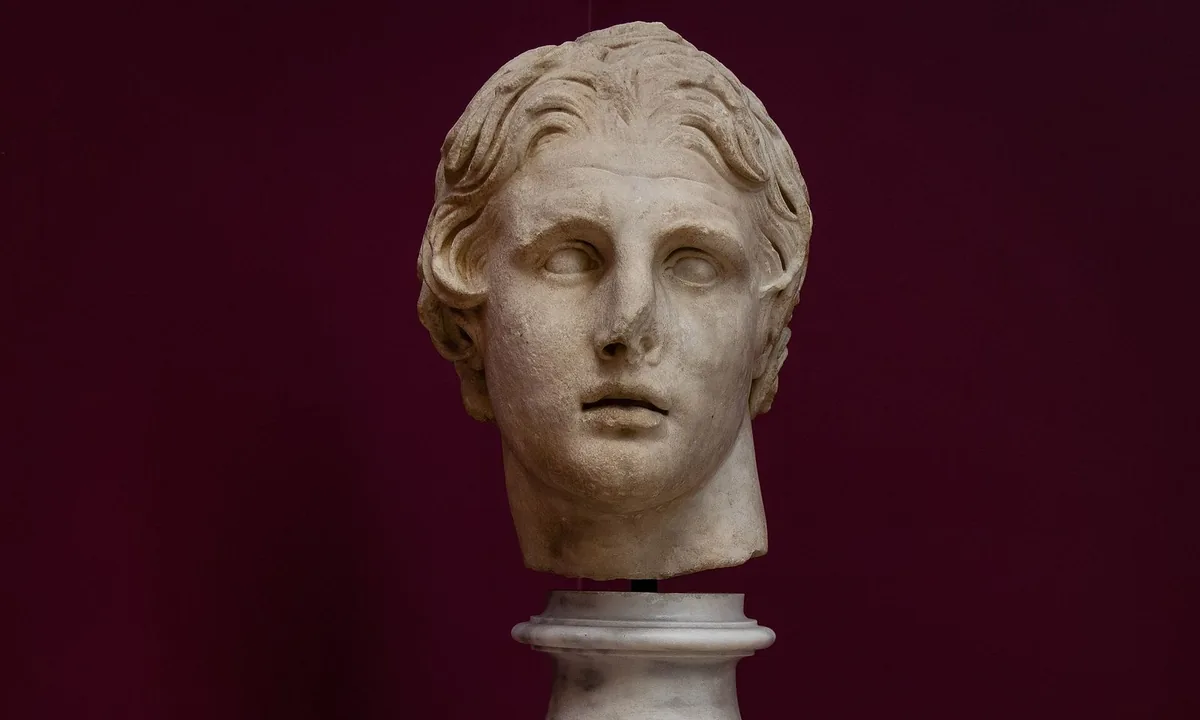
In the summer of 326 BCE, on the banks of the river Hyphasis in the Punjab, a king who had never lost a battle met an enemy he could not beat: his own soldiers. After eight years of marching from Macedonia, they refused to go one step farther east.
A king at twenty
Alexander was born in 356 BCE at Pella, the son of Philip II and Olympias, a princess of Epirus. From the age of thirteen he was taught by the philosopher Aristotle. At eighteen he commanded a wing at Chaeronea.
In 336 BCE Philip was stabbed to death by one of his bodyguards at a family wedding, and Alexander became king at twenty. When Thebes revolted the next year, he took the city, killed thousands, sold the survivors into slavery and razed it, sparing, the story goes, the house of the poet Pindar. The rest of Greece took the hint.
Three battles for an empire
In 334 BCE Alexander crossed into Asia with, Arrian says, not much more than 30,000 infantry and over 5,000 cavalry, claiming revenge for Xerxes' invasion of Greece. He won his first battle at the river Granicus. At Issus in 333 BCE the Persian king, Darius III, fled, leaving his mother, wife and children in Alexander's hands.
Alexander did not chase him. He took the coast first, besieging Tyre for seven months, so the Persian fleet would have no ports. In 331 BCE he beat Darius again at Gaugamela, in what is now northern Iraq. Darius was murdered by his own officers the next year.

Pharaoh, Great King, son of a god?
Egypt, tired of Persian rule, opened its gates in 332 BCE. Alexander founded Alexandria on the coast and crossed the desert to the oracle of Ammon at Siwa, whose priest greeted him, the ancient writers say, as son of the god.
In 330 BCE his army burned the palace at Persepolis: revenge for Athens, or a drunken party, depending on the source. He began to wear Persian dress and use Persian court ceremony. Many Macedonians hated it, and in 328 BCE he killed his old friend Cleitus with a spear in a drunken quarrel.
To the edge of the known world
Three years of hard fighting in Bactria and Sogdiana, today's Afghanistan and Uzbekistan, ended with his marriage to Roxana, a local noblewoman. In 326 BCE he crossed into India and defeated King Porus and his war elephants at the river Hydaspes.
At the Hyphasis the army mutinied, and Alexander turned back. Part of the army returned through the Gedrosian desert, in today's Pakistan and Iran, where heat and thirst killed many of those who had survived every battle.

Death in Babylon
Back in Babylon, Alexander planned new campaigns, perhaps to Arabia. In June 323 BCE he fell ill after a night of drinking and died about ten days later, aged 32. Ancient writers repeated rumours of poison, which Arrian reports and doubts; modern suggestions include malaria, typhoid and the effects of heavy drinking. No one knows.
Asked, some said, to whom he left his kingdom, he answered: “to the strongest.” His generals fought over it for forty years. Ptolemy took Egypt, Seleucus most of Asia, and Greek became the language of power from Egypt to Afghanistan.

In their own words
“It is said that when his soldiers passed by him he was unable to speak; yet he greeted each of them with his right hand, raising his head with difficulty and making a sign with his eyes.”
Arrian, Anabasis of Alexander 7.26, 2nd century CE
Translation by E. J. Chinnock (1884). Arrian wrote over four centuries after Alexander's death, using lost histories by Ptolemy and Aristobulus, who had served with him.
Why it happened
- Philip II left Alexander a professional army and a plan to invade Persia.
- The Persian Empire was vast but depended on one king; once Darius fled and died, its provinces could be taken one by one.
- Alexander's ambition, and his claim to be avenging Xerxes' invasion of Greece.
What happened next
- Alexander's generals carved his empire into kingdoms; the Ptolemies ruled Egypt until Cleopatra. Read the story →
- Greek became the shared language of the eastern Mediterranean, the language of the New Testament three centuries later.
- Rome conquered the Hellenistic kingdoms one by one, taking Egypt last, in 30 BCE. Read the story →
Why it still matters
Who owns Alexander is still a live question. In 2011 Skopje put up a huge statue of a warrior on horseback that everyone recognised as him, and Greece objected to its northern neighbour calling itself Macedonia at all. The Prespa Agreement of 2018 settled the dispute: in 2019 the country became North Macedonia.
Key people
- Alexander III of Macedon
- King of Macedon (336–323 BCE) who conquered the Persian Empire
- Philip II
- His father, who built the army Alexander inherited
- Aristotle
- Philosopher, a student of Plato's Academy, who tutored the teenage Alexander
- Darius III
- The last Achaemenid king of Persia, beaten at Issus and Gaugamela
- Ptolemy
- Alexander's general who took Egypt and founded the dynasty that ended with Cleopatra
Key terms
- Companions
- The Macedonian nobles who rode with the king as his elite cavalry and advisers.
- Hellenistic
- The age after Alexander (323–30 BCE), when Greek-speaking kings ruled from Egypt to Afghanistan.
- Proskynesis
- The Persian custom of bowing or prostrating before the king, which Alexander tried to introduce at his court.
- Diadochi
- “The Successors”: Alexander's generals, who fought over and divided his empire.
Test yourself
Who taught Alexander when he was a teenager?
- Plato
- Socrates
- Aristotle
- Demosthenes
Show the answer
Aristotle. Philip hired Aristotle, who had studied at Plato's Academy, to teach his son from about 343 BCE.
The full lesson in the app ends with 5 questions like this one.
Connected stories
- The Persian Wars: Marathon and Thermopylae: Alexander presented his invasion as revenge for Xerxes' burning of Athens in 480 BCE.
- Cleopatra: The Last Queen of Egypt: Cleopatra was the last ruler of the dynasty founded by Alexander's general Ptolemy.
- The Rosetta Stone: Cracking the Code of the Pharaohs: The Rosetta Stone's Greek text exists because Alexander's successors ruled Egypt in Greek.
- The Ides of March: Suetonius says Caesar, seeing a statue of Alexander in Spain, lamented that he had done nothing memorable at an age when Alexander had conquered the world.
Frequently asked questions
Why could Alexander conquer the Persian Empire?
Philip II left Alexander a professional army and a plan to invade Persia. The Persian Empire was vast but depended on one king; once Darius fled and died, its provinces could be taken one by one. Alexander's ambition, and his claim to be avenging Xerxes' invasion of Greece.
What happened to Alexander's empire after he died?
Alexander's generals carved his empire into kingdoms; the Ptolemies ruled Egypt until Cleopatra. Greek became the shared language of the eastern Mediterranean, the language of the New Testament three centuries later. Rome conquered the Hellenistic kingdoms one by one, taking Egypt last, in 30 BCE.
Who taught Alexander when he was a teenager?
Aristotle. Philip hired Aristotle, who had studied at Plato's Academy, to teach his son from about 343 BCE.
What is the main primary source for “Alexander the Great: From Macedon to India”?
Arrian, Anabasis of Alexander 7.26 (2nd century CE). Translation by E. J. Chinnock (1884). Arrian wrote over four centuries after Alexander's death, using lost histories by Ptolemy and Aristobulus, who had served with him.
Sources
- Arrian, Anabasis of Alexander
- Plutarch, Life of Alexander
- Robin Lane Fox, Alexander the Great (1973)
- Paul Cartledge, Alexander the Great: The Hunt for a New Past (2004)
Images are credited under each picture. Paintings and photographs come from public collections via Wikimedia Commons; scenes with no surviving image are marked as illustrations.
