Ancient Egypt · 51–30 BCE
How Did Cleopatra Die? The Last Queen of Egypt
In short
- Cleopatra VII, a Macedonian Greek who learned Egyptian unlike the kings before her, ruled from 51 to 30 BCE.
- She allied with Julius Caesar and then Mark Antony; Octavian defeated them at Actium in 31 BCE.
- She died in August 30 BCE, probably by poison; even Plutarch admitted no one knew whether it was an asp.
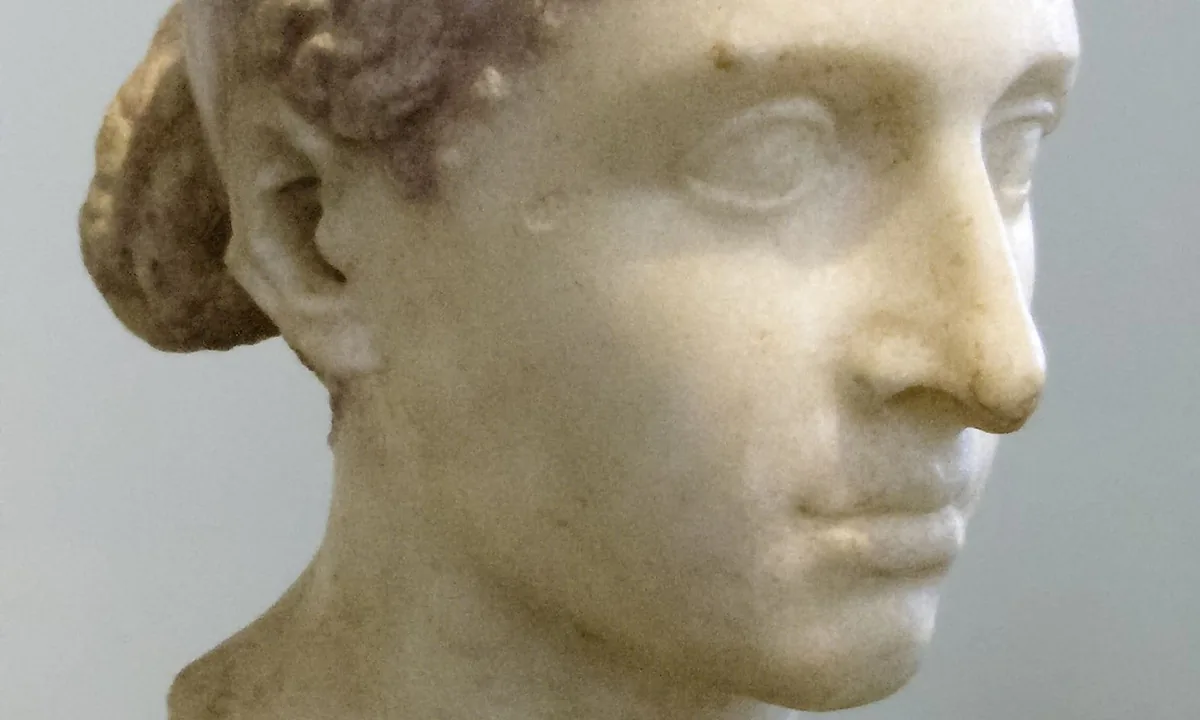
In August 30 BCE, Octavian's guards forced open the doors of a mausoleum in Alexandria. Inside, the queen of Egypt lay dead on a golden couch in her royal robes, one maid dying at her feet and another straightening her crown. How she died has been argued about ever since.
A Greek queen of Egypt
Cleopatra VII was born in 69 BCE into the Ptolemaic dynasty, Macedonian Greeks who had ruled Egypt since the death of Alexander the Great. They married their siblings, as pharaohs had done, and they rarely bothered with Egyptian.
Cleopatra did. Plutarch says she spoke many languages, while the kings before her had not even tried to learn Egyptian. She came to the throne in 51 BCE, aged about eighteen, sharing it with her younger brother Ptolemy XIII. His advisers soon drove her out.
Caesar
In 48 BCE Julius Caesar arrived in Alexandria, chasing his defeated rival Pompey, whom Ptolemy's men had already murdered. Cleopatra needed to reach Caesar past her brother's guards. Plutarch says she was carried into the palace hidden in a bedding sack; the rolled-up carpet comes from later retellings.
Caesar backed her, defeated her brother's army, and stayed in Egypt for months. In 47 BCE she bore a son, Ptolemy Caesar, nicknamed Caesarion. She was in Rome, staying in Caesar's villa, when he was assassinated in March 44 BCE.

Antony
Caesar's heirs split the Roman world. Mark Antony took the East and summoned Cleopatra to Tarsus in 41 BCE. She arrived on a barge with a gilded stern and purple sails, dressed as Aphrodite. They became allies and lovers and had three children; the twins were named Alexander Helios and Cleopatra Selene, the Sun and the Moon.
In 34 BCE, in a ceremony in Alexandria, Antony gave eastern lands to Cleopatra and her children. In Rome, Caesar's adopted son Octavian used it to paint Antony as a man enslaved by a foreign queen. War was declared on Cleopatra, not on Antony.

Actium and the end
On 2 September 31 BCE the fleets met off Actium in western Greece. Cleopatra's squadron broke away and sailed for Egypt, and Antony followed. Whether it was a planned escape or a panic, the war was lost. A year later Octavian reached Alexandria; Antony stabbed himself after a false report of Cleopatra's death.
Cleopatra knew Octavian meant to parade her through Rome in his triumph. Plutarch tells the famous story of an asp smuggled in a basket of figs, but adds that no one knew the truth: some said she kept poison in a hollow comb, and no sign of poison showed on her body. Modern historians also suggest a prepared poison. She was 39.

Beauty, myth and the last pharaoh
Roman poets painted Cleopatra as a dangerous seductress, because Octavian needed a foreign enemy. Plutarch, writing a century later, says her beauty was not outstanding but her conversation was irresistible. Her coins show a strong nose and chin.
Octavian had Caesarion killed and made Egypt a Roman province under his personal control. Three thousand years of independent pharaonic rule were over. Cleopatra lived closer in time to us than to the builders of the Great Pyramid.
In their own words
“But the truth of the matter no one knows; for it was also said that she carried about poison in a hollow comb and kept the comb hidden in her hair; and yet neither spot nor other sign of poison broke out upon her body.”
Plutarch, Life of Antony 86, early 2nd century CE
Translation by Bernadotte Perrin (Loeb Classical Library, 1920). Plutarch wrote about 130 years after her death; he tells the asp story first, then admits nobody knew.
Why it happened
- Rome's civil wars made Egypt's wealth and grain a prize for every Roman leader.
- Cleopatra allied with Caesar and then Antony to keep her throne and expand her kingdom.
- Octavian presented the war as one against a foreign queen to win Roman support against Antony.
What happened next
- Egypt became a Roman province governed for the emperor. Read the story →
- Caesarion was killed, ending the Ptolemaic line.
- Octavian, now unrivalled, became Augustus, Rome's first emperor, in 27 BCE. Read the story →
Why it still matters
Cleopatra's tomb has never been found. Since 2005 the Dominican archaeologist Kathleen Martínez has been excavating the temple of Taposiris Magna west of Alexandria in the hope that Cleopatra and Antony were buried nearby, so far without finding them.
Key people
- Cleopatra VII
- Queen of Egypt 51–30 BCE, last active ruler of the Ptolemaic dynasty
- Julius Caesar
- Roman general who backed Cleopatra in 48–47 BCE and fathered Caesarion
- Mark Antony
- Roman general, Cleopatra's ally and partner from 41 BCE until his suicide in 30 BCE
- Octavian
- Caesar's heir, victor at Actium, later the emperor Augustus
- Caesarion
- Cleopatra's son by Caesar and co-ruler as Ptolemy XV, killed on Octavian's orders in 30 BCE
Key terms
- Ptolemaic dynasty
- The Macedonian Greek family that ruled Egypt from 305 to 30 BCE, founded by Alexander's general Ptolemy.
- Alexandria
- The Greek city on Egypt's coast founded by Alexander, capital of the Ptolemies and home of the great Library.
- Battle of Actium
- The naval battle of 2 September 31 BCE in which Octavian defeated Antony and Cleopatra.
- Triumph
- A Roman victory parade in which captured enemies were displayed through the streets of Rome.
Test yourself
What was Cleopatra's family background?
- Egyptian, descended from Ramses II
- Roman, a cousin of Julius Caesar
- Macedonian Greek, of the Ptolemaic dynasty
- Persian, from the royal family of Darius
Show the answer
Macedonian Greek, of the Ptolemaic dynasty. The Ptolemies descended from Ptolemy, a Macedonian general of Alexander the Great. Plutarch says the kings before Cleopatra had not even tried to learn Egyptian.
The full lesson in the app ends with 5 questions like this one.
Connected stories
- The Ides of March: Caesar's alliance with Cleopatra began in Alexandria in 48 BCE.
- Augustus: How a Republic Became a Monarchy: Victory over Cleopatra left Octavian master of the Roman world.
- Alexander the Great: From Macedon to India: Cleopatra's dynasty descended from Ptolemy, one of Alexander's generals.
- How the Great Pyramid Was Built: The Great Pyramid was already about 2,500 years old in Cleopatra's lifetime.
Frequently asked questions
Why did Cleopatra take her own life?
Rome's civil wars made Egypt's wealth and grain a prize for every Roman leader. Cleopatra allied with Caesar and then Antony to keep her throne and expand her kingdom. Octavian presented the war as one against a foreign queen to win Roman support against Antony.
What happened to Egypt after Cleopatra died?
Egypt became a Roman province governed for the emperor. Caesarion was killed, ending the Ptolemaic line. Octavian, now unrivalled, became Augustus, Rome's first emperor, in 27 BCE.
What was Cleopatra's family background?
Macedonian Greek, of the Ptolemaic dynasty. The Ptolemies descended from Ptolemy, a Macedonian general of Alexander the Great. Plutarch says the kings before Cleopatra had not even tried to learn Egyptian.
What is the main primary source for “Cleopatra: The Last Queen of Egypt”?
Plutarch, Life of Antony 86 (early 2nd century CE). Translation by Bernadotte Perrin (Loeb Classical Library, 1920). Plutarch wrote about 130 years after her death; he tells the asp story first, then admits nobody knew.
Sources
- Plutarch, Life of Antony 25–29 and 71–86; Life of Caesar 48–49
- Cassius Dio, Roman History, Book 51
- Joyce Tyldesley, Cleopatra: Last Queen of Egypt (2008)
- Stacy Schiff, Cleopatra: A Life (2010)
Images are credited under each picture. Paintings and photographs come from public collections via Wikimedia Commons; scenes with no surviving image are marked as illustrations.
