Ancient Egypt · c. 2589–2566 BCE (reign of Khufu)
How Were the Pyramids Built?
In short
- The Great Pyramid was built for Khufu around 2560 BCE, after a century of experiments from Djoser's Step Pyramid onward.
- Paid and conscripted Egyptian workers, not slaves, built it, fed from bakeries and breweries in a town beside the site.
- Ramps, sledges, boats and careful planning explain the construction; the exact ramp design is still debated.
Last time: around 3100 BCE, the valley and the Delta became one kingdom, ruled from Memphis.
In 2013, in a cave on the Red Sea coast, archaeologists found scraps of papyrus about 4,500 years old. They were the logbook of an inspector named Merer, whose team spent months ferrying limestone down the Nile to Giza. He was writing about the Great Pyramid while it was being built.
From step to smooth
Egypt's first kings were buried under low, flat-topped tombs of mudbrick. Around 2650 BCE, King Djoser's architect Imhotep stacked six of them in stone at Saqqara: the Step Pyramid, the oldest large stone building in the world.
Djoser's successors experimented. King Sneferu built three pyramids; one, at Dahshur, changes its angle halfway up, probably because the builders feared it would collapse. His son Khufu chose a site on the plateau at Giza and ordered the largest of them all.
The numbers
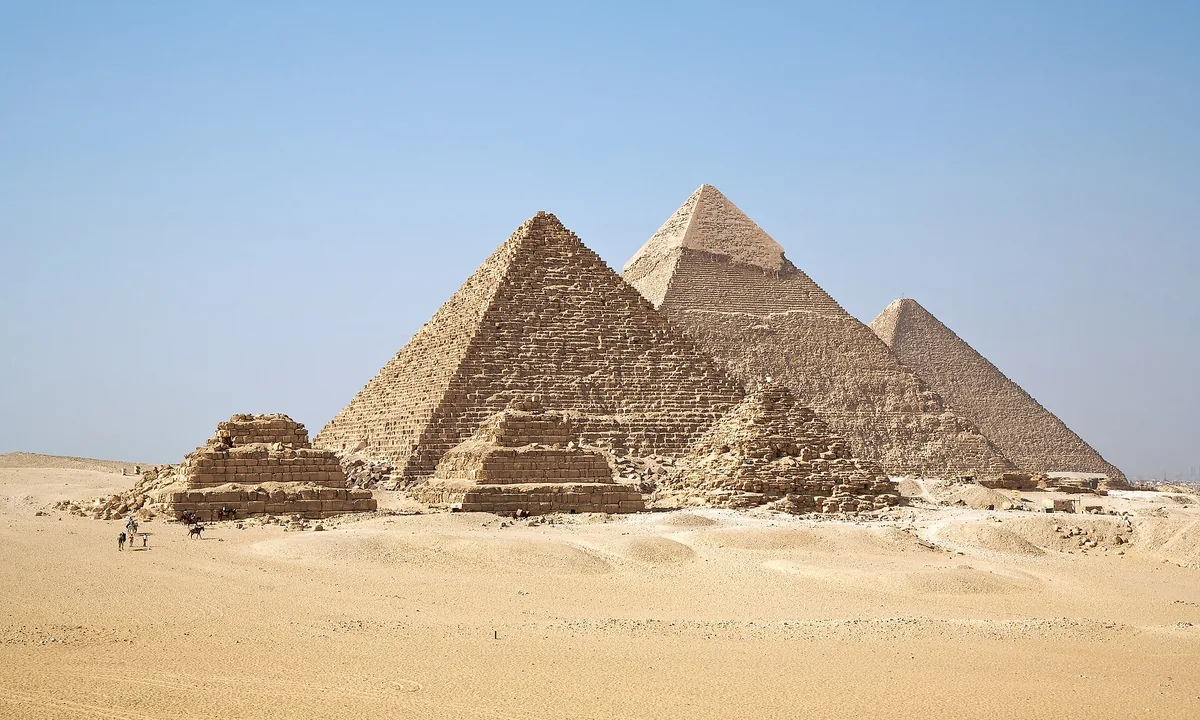
Khufu's pyramid rose about 146 metres. It contains an estimated 2.3 million blocks, most of local limestone; the finest white casing stone came from Tura across the river, and granite for the king's burial chamber from Aswan, some 800 kilometres south.
Its sides face north, south, east and west with an error of a fraction of a degree, probably set by watching the stars. For more than 3,800 years, until a cathedral spire in England overtopped it in the 14th century, it was the tallest structure people had ever built.

Merer's logbook
The papyri found at Wadi al-Jarf by Pierre Tallet's team are the oldest inscribed papyri known. They record a crew of about 40 men under Merer, working around Khufu's 26th or 27th year on the throne. Every few days they loaded limestone at the Tura quarries, sailed it to Giza along canals and a harbour basin, and went back for more.
The logbook names their boss, Ankhhaf, Khufu's half-brother, in charge of the harbour at Giza. It is administration, not poetry: the pyramid ran on paperwork, boats and schedules.
Who did the work
The ancient Greek writer Herodotus claimed that 100,000 men toiled in three-month shifts. He wrote 2,000 years after the event, and his figure is a guess. The popular idea that slaves built the pyramids has no support from Egyptian evidence.
Since around 1990, excavations by Zahi Hawass and Mark Lehner have found the builders' town and cemetery south of the pyramids: bakeries, breweries, barracks and the bones of cattle and sheep. Skeletons show healed fractures and even amputations, so injured workers were treated. Estimates now put the workforce at perhaps 20,000–30,000, including skilled permanent crews and farmers serving their turn of labour for the state.

Ramps, sledges and water
No one knows exactly how the blocks went up. Most Egyptologists favour ramps of mudbrick and rubble, but argue over their shape: straight, zigzagging up one face, or spiralling round the pyramid. In 2018 a ramp with staircases and post holes for ropes, dating back at least to Khufu's reign, was found at the Hatnub alabaster quarry.
Blocks travelled on wooden sledges. A tomb painting of about 1900 BCE shows a man pouring water in front of a sledge carrying a colossal statue; in 2014 physicists showed that wet sand roughly halves the force needed to drag a load. No mystery or lost technology is required, only organisation on an enormous scale.
In their own words
“They worked in gangs of a hundred thousand men, each gang for three months. For ten years the people wore themselves out building the road over which the stones were dragged…”
Herodotus, Histories 2.124, c. 430 BCE
Translation by A. D. Godley (Loeb Classical Library, 1920), who spells the king's name Kheops. Herodotus wrote about 2,000 years after the pyramid was built; his numbers are hearsay, not records.
Why it happened
- Kings were believed to join the gods at death, and the pyramid was the machine that sent them there.
- A united state could feed, house and organise tens of thousands of workers from surplus grain.
- Generations of experiment from Djoser to Sneferu taught builders how to raise a true pyramid safely.
What happened next
- Inside the pyramids, kings' bodies were preserved by embalmers for the afterlife. Read the story →
- Later pyramids shrank, and New Kingdom kings hid their tombs in the Valley of the Kings instead. Read the story →
- Greek visitors counted the Great Pyramid among the Seven Wonders of the World; it is the only one still standing.
Why it still matters
The Great Pyramid is the only one of the Seven Wonders of the Ancient World that still stands. Merer's papyri were first displayed in 2016 at the Egyptian Museum in Cairo, a few kilometres from the stones his crew delivered.
Key people
- Khufu
- Pharaoh (reigned c. 2589–2566 BCE) for whom the Great Pyramid was built; the Greeks called him Cheops
- Imhotep
- Architect of Djoser's Step Pyramid at Saqqara, c. 2650 BCE, later worshipped as a god of wisdom
- Merer
- Inspector whose logbook, found in 2013, records shipping limestone to Giza
- Ankhhaf
- Khufu's half-brother, named in Merer's logbook as head of the works at Giza's harbour
Key terms
- Mastaba
- A flat-topped rectangular tomb; Djoser's Step Pyramid began as a stack of them.
- Casing stones
- The polished white limestone that once covered the pyramids' stepped cores, mostly stripped in the Middle Ages.
- Corvée
- Compulsory labour owed to the state for a period, the likely way many farmers joined the building crews.
- Old Kingdom
- The age of the great pyramids, c. 2686–2181 BCE, when Egypt was ruled from Memphis.
Test yourself
What did the papyri found at Wadi al-Jarf in 2013 record?
- The spells written inside the king's burial chamber
- A census of the slaves who built the pyramid
- An inspector's log of shipping limestone to Giza
- Khufu's orders for the shape of the pyramid
Show the answer
An inspector's log of shipping limestone to Giza. Merer's logbook records his crew moving limestone from the Tura quarries to Giza by boat. It is the only known eyewitness record of the Great Pyramid being built.
The full lesson in the app ends with 5 questions like this one.
Connected stories
- Narmer and the Two Lands: The united kingdom built under the first kings could command the labour the pyramids needed.
- Mummies: Seventy Days to Eternity: The oldest evidence for removing a body's organs comes from the burial of Khufu's mother, Hetepheres.
- Cleopatra: The Last Queen of Egypt: Cleopatra lived closer in time to the Moon landing than to the building of the Great Pyramid.
- 1066: The Norman Conquest: The structure that finally overtopped the pyramid, Lincoln Cathedral, was begun under the Normans.
Frequently asked questions
Why did the Egyptians build pyramids?
Kings were believed to join the gods at death, and the pyramid was the machine that sent them there. A united state could feed, house and organise tens of thousands of workers from surplus grain. Generations of experiment from Djoser to Sneferu taught builders how to raise a true pyramid safely.
What happened after the age of the great pyramids?
Inside the pyramids, kings' bodies were preserved by embalmers for the afterlife. Later pyramids shrank, and New Kingdom kings hid their tombs in the Valley of the Kings instead. Greek visitors counted the Great Pyramid among the Seven Wonders of the World; it is the only one still standing.
What did the papyri found at Wadi al-Jarf in 2013 record?
An inspector's log of shipping limestone to Giza. Merer's logbook records his crew moving limestone from the Tura quarries to Giza by boat. It is the only known eyewitness record of the Great Pyramid being built.
What is the main primary source for “How the Great Pyramid Was Built”?
Herodotus, Histories 2.124 (c. 430 BCE). Translation by A. D. Godley (Loeb Classical Library, 1920), who spells the king's name Kheops. Herodotus wrote about 2,000 years after the pyramid was built; his numbers are hearsay, not records.
Sources
- Herodotus, Histories, Book 2.124–2.125
- Mark Lehner, The Complete Pyramids (1997)
- Pierre Tallet and Mark Lehner, The Red Sea Scrolls: How Ancient Papyri Reveal the Secrets of the Pyramids (2021)
- Mark Lehner and Zahi Hawass, Giza and the Pyramids (2017)
Images are credited under each picture. Paintings and photographs come from public collections via Wikimedia Commons; scenes with no surviving image are marked as illustrations.
