Ancient Greece · 483–480 BCE
What Happened at the Battle of Salamis? Themistocles' Gamble
In short
- Themistocles persuaded Athens to spend a silver windfall on triremes, and read the Delphic oracle's 'wooden wall' as the fleet.
- His secret message lured Xerxes' fleet into the narrow straits of Salamis in September 480 BCE, where it was badly beaten.
- The hero of Salamis was later ostracised and ended his life as a governor for the Persian king.
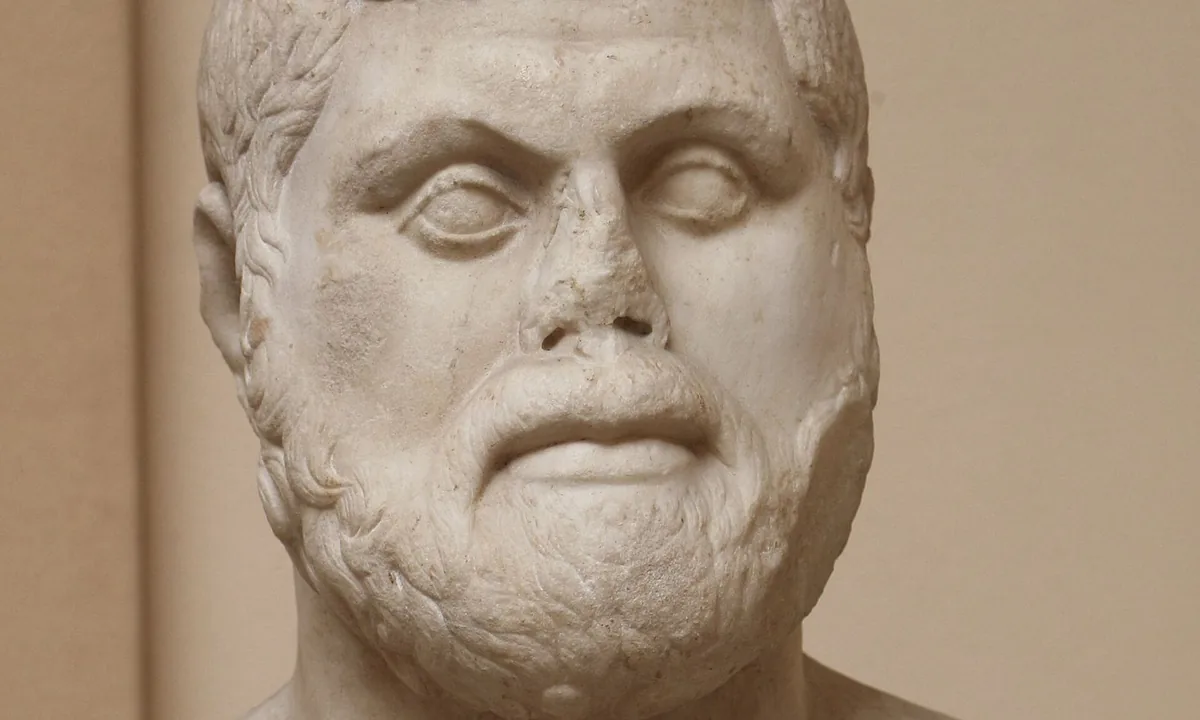
In 483 BCE miners at Laurion, south of Athens, struck a rich vein of silver. The Athenians planned to share out the money among themselves. One man talked them into building warships instead, and three years later those ships were all that stood between Greece and the king of Persia.
Silver into ships
Themistocles, son of Neocles, did not come from Athens' oldest families, but he saw earlier than most that Athens' future lay at sea. When the Laurion silver came in, he persuaded the Assembly to spend it on a fleet. Herodotus says 200 ships, built for a war with the nearby island of Aegina; Aristotle's Constitution of Athens says 100.
The ship was the trireme: about 37 metres long, driven by some 170 rowers on three levels, with a bronze ram at the bow. Rowers did not need armour, so poorer citizens could serve. Athens' new strength rested on its poorest men.

The wooden wall
As Xerxes approached, the Athenians asked the oracle at Delphi for advice. The first answer told them to flee to the ends of the earth. The second, Herodotus says, promised that a “wooden wall” would not fail them and spoke of “divine Salamis”.
Some thought the wooden wall meant the old fence round the Acropolis. Themistocles argued it meant the ships. The Athenians took his reading: they sent their families to Troezen, Aegina and Salamis and manned the fleet. An inscription found at Troezen in 1959 claims to record his evacuation decree, but it was carved about two centuries later and its authenticity is debated.
A message for the king
After Thermopylae the Persians burned the abandoned Acropolis. The allied fleet, under the Spartan Eurybiades, lay off Salamis, and the Peloponnesian captains wanted to fall back and defend the Isthmus of Corinth. Themistocles threatened that the Athenians would sail away and found a new city in Italy.
Then he sent his slave Sicinnus to Xerxes with a message: the Greeks were about to flee, and Themistocles was secretly on the king's side. Xerxes ordered his fleet to close the exits of the straits during the night.
Battle in the straits
At dawn in September 480 BCE the Persian ships rowed into the narrow channel between Salamis and the mainland. The Greeks had about 380 triremes, 180 of them Athenian; the Persian fleet was larger, but in the straits its numbers became a crowd. Greek ships rammed, backed off and rammed again.
Xerxes watched from a throne on the slopes of Mount Aegaleos. Aristides landed Athenian hoplites on the islet of Psyttaleia and killed the Persians stationed there. By the historian Diodorus' count, the Greeks lost 40 ships and the Persians more than 200.

Hero, exile, Persian governor
In 479 BCE Themistocles stalled the Spartans with talk while every Athenian, Thucydides says, worked on the city's new walls. Success made him enemies. Around 471 BCE he was ostracised, and later condemned for treason with Persia.
He fled, of all places, to the Persian court. Xerxes' son Artaxerxes I made him governor of Magnesia in Asia Minor, where he died around 459 BCE; Thucydides says of illness, though some claimed he took poison.

In their own words
“A Hellene, from the Athenian host, came to your son Xerxes and told this tale: that, when the gloom of black night should set in, the Hellenes would not remain in place, but, springing upon the rowing benches of their ships, would seek, some here, some there, to preserve their lives by stealthy flight.”
Aeschylus, The Persians, lines 355–360, 472 BCE
Translation by Herbert Weir Smyth (Loeb Classical Library, 1926). A Persian messenger reports Themistocles' trick to Xerxes' mother. Aeschylus, a veteran of Marathon, staged the play in Athens eight years after the battle.
Why it happened
- The Laurion silver strike gave Athens the money for a large fleet, and Themistocles persuaded it to build one.
- Thermopylae fell, leaving the fleet as the Greeks' best hope of stopping Xerxes.
- Themistocles' message lured the Persians into fighting in narrow waters where their numbers did not count.
What happened next
- Xerxes went home; his army was beaten at Plataea the next year. Read the story →
- With the largest navy in Greece, Athens took the lead of an anti-Persian alliance. Read the story →
- The rowers who won Salamis were poorer citizens, which strengthened their voice in the democracy. Read the story →
Why it still matters
Nobody knew for sure how a trireme worked until the Greek navy built one. The reconstructed Olympias, launched in 1987, was rowed by volunteer crews in sea trials that tested ancient descriptions of speed and manoeuvre. It is still a commissioned ship of the Hellenic Navy, based at Palaio Faliro near Athens.
Key people
- Themistocles
- Athenian statesman (c. 524–c. 459 BCE) who built the fleet and engineered the battle of Salamis
- Eurybiades
- Spartan commander of the allied Greek fleet in 480 BCE
- Xerxes I
- King of Persia, who watched the defeat of his fleet from the shore
- Aristides
- Themistocles' rival, recalled from exile, who cleared Psyttaleia during the battle
- Aeschylus
- Athenian playwright and veteran of Marathon whose play The Persians (472 BCE) describes Salamis
Key terms
- Trireme
- A Greek warship rowed by about 170 men on three levels, armed with a bronze ram.
- Ram
- A bronze-sheathed beak at the waterline of a warship, used to hole enemy hulls.
- Laurion
- Silver-mining district in southern Attica whose output paid for Athens' fleet and coins.
- Oracle of Delphi
- The shrine of Apollo where a priestess, the Pythia, gave answers to questions from cities and individuals.
Test yourself
What did Themistocles persuade the Athenians to do with the silver from Laurion?
- Share it out among all the citizens
- Pay Sparta to defend Attica
- Rebuild the temples on the Acropolis
- Build a fleet of warships
Show the answer
Build a fleet of warships. He persuaded the Assembly to spend the windfall on triremes, the fleet that fought at Salamis three years later.
The full lesson in the app ends with 5 questions like this one.
Connected stories
- The Persian Wars: Marathon and Thermopylae: Salamis was fought weeks after Thermopylae, in the same invasion.
- Aristides and the Delian League: The fleet built for Salamis became the core of the Delian League's navy.
- The Punic Wars: Rome Against Carthage: Athens planned its navy years ahead; Rome had to improvise one in a hurry to fight Carthage.
Frequently asked questions
Why did the Greeks fight at Salamis?
The Laurion silver strike gave Athens the money for a large fleet, and Themistocles persuaded it to build one. Thermopylae fell, leaving the fleet as the Greeks' best hope of stopping Xerxes. Themistocles' message lured the Persians into fighting in narrow waters where their numbers did not count.
What happened after the Battle of Salamis?
Xerxes went home; his army was beaten at Plataea the next year. With the largest navy in Greece, Athens took the lead of an anti-Persian alliance. The rowers who won Salamis were poorer citizens, which strengthened their voice in the democracy.
What did Themistocles persuade the Athenians to do with the silver from Laurion?
Build a fleet of warships. He persuaded the Assembly to spend the windfall on triremes, the fleet that fought at Salamis three years later.
What is the main primary source for “Themistocles and the Battle of Salamis”?
Aeschylus, The Persians, lines 355–360 (472 BCE). Translation by Herbert Weir Smyth (Loeb Classical Library, 1926). A Persian messenger reports Themistocles' trick to Xerxes' mother. Aeschylus, a veteran of Marathon, staged the play in Athens eight years after the battle.
Sources
- Herodotus, Histories 7.139–144 and 8.40–96
- Thucydides, History of the Peloponnesian War 1.89–93 and 1.135–138
- Aeschylus, The Persians
- Barry Strauss, The Battle of Salamis: The Naval Encounter that Saved Greece — and Western Civilization (2004)
Images are credited under each picture. Paintings and photographs come from public collections via Wikimedia Commons; scenes with no surviving image are marked as illustrations.
